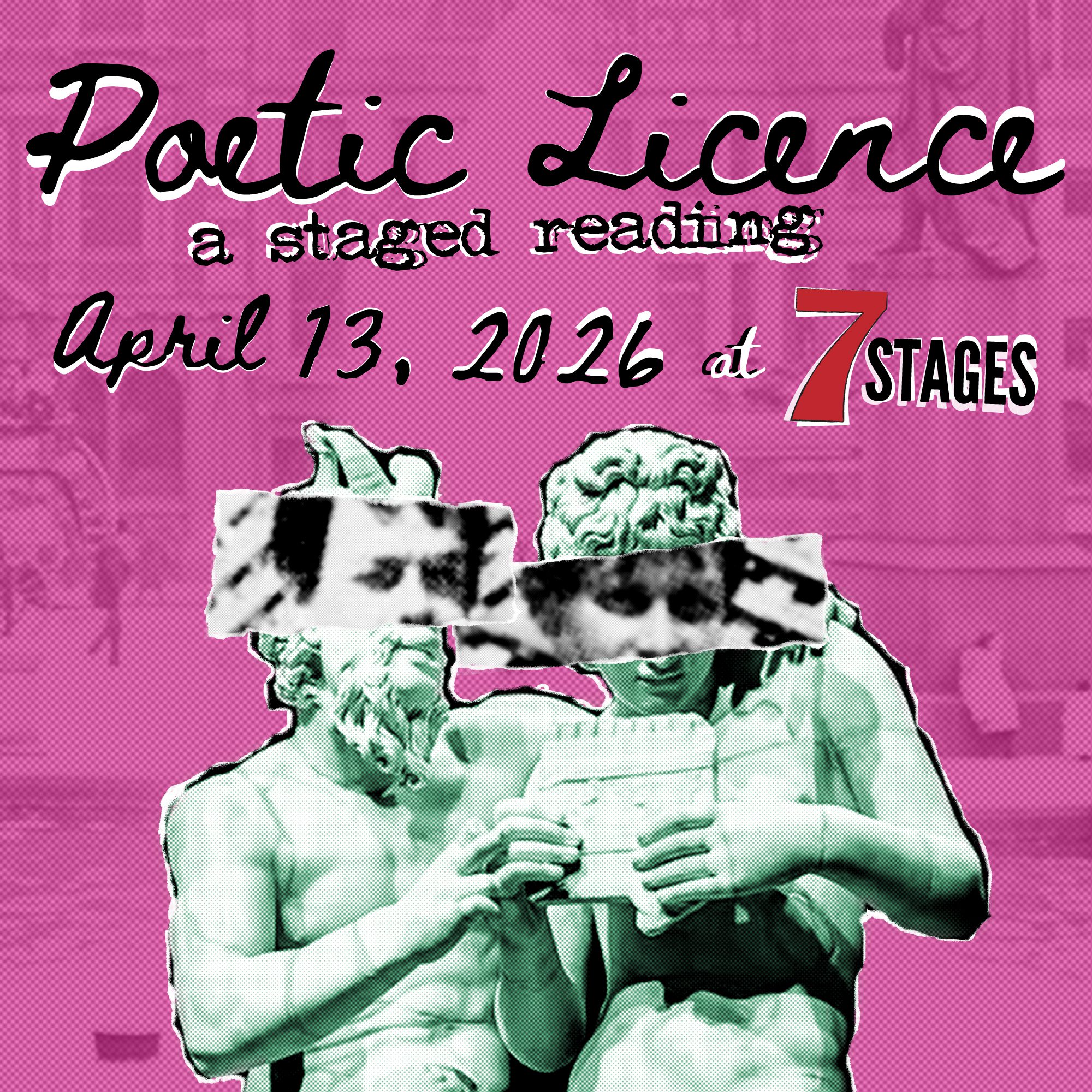

Introducing Poetic Licence – Frank Siera
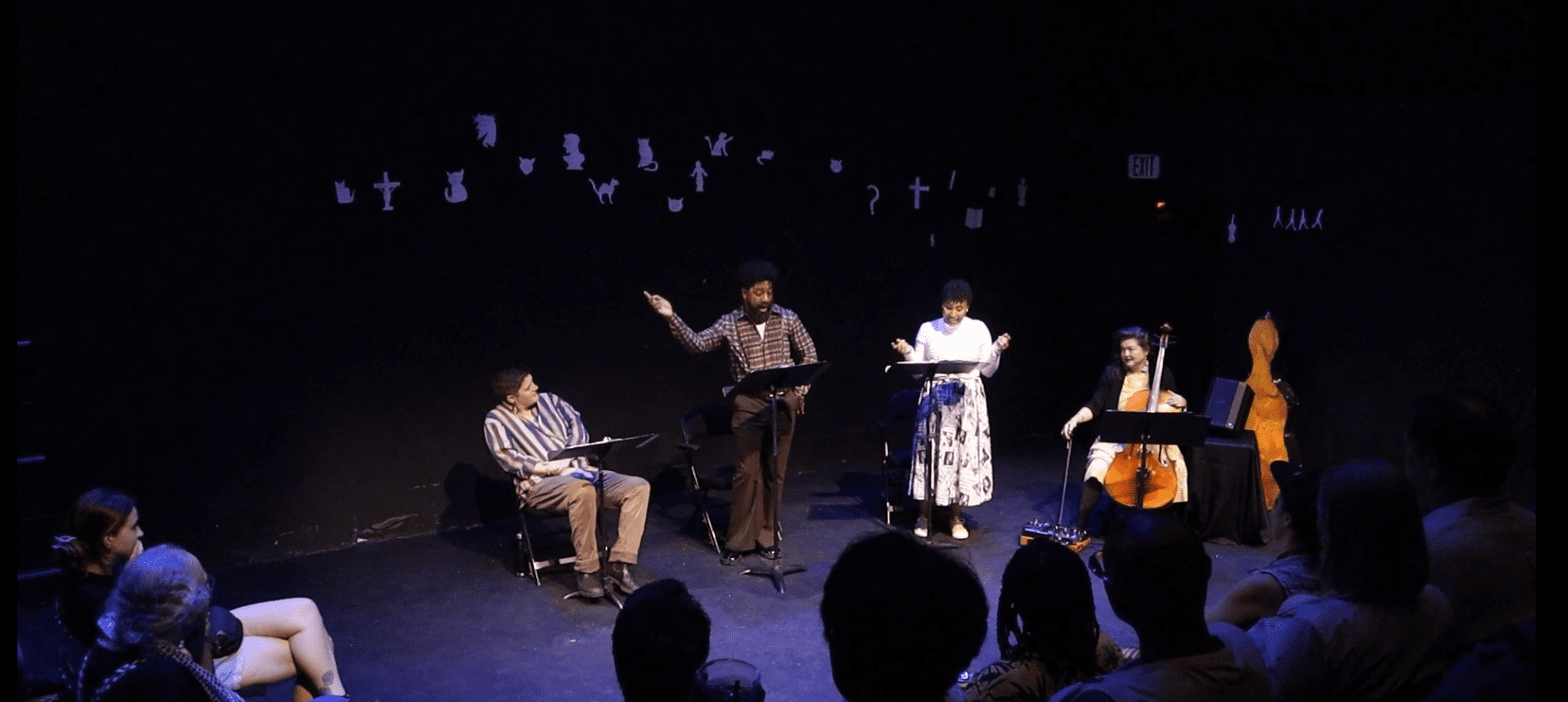
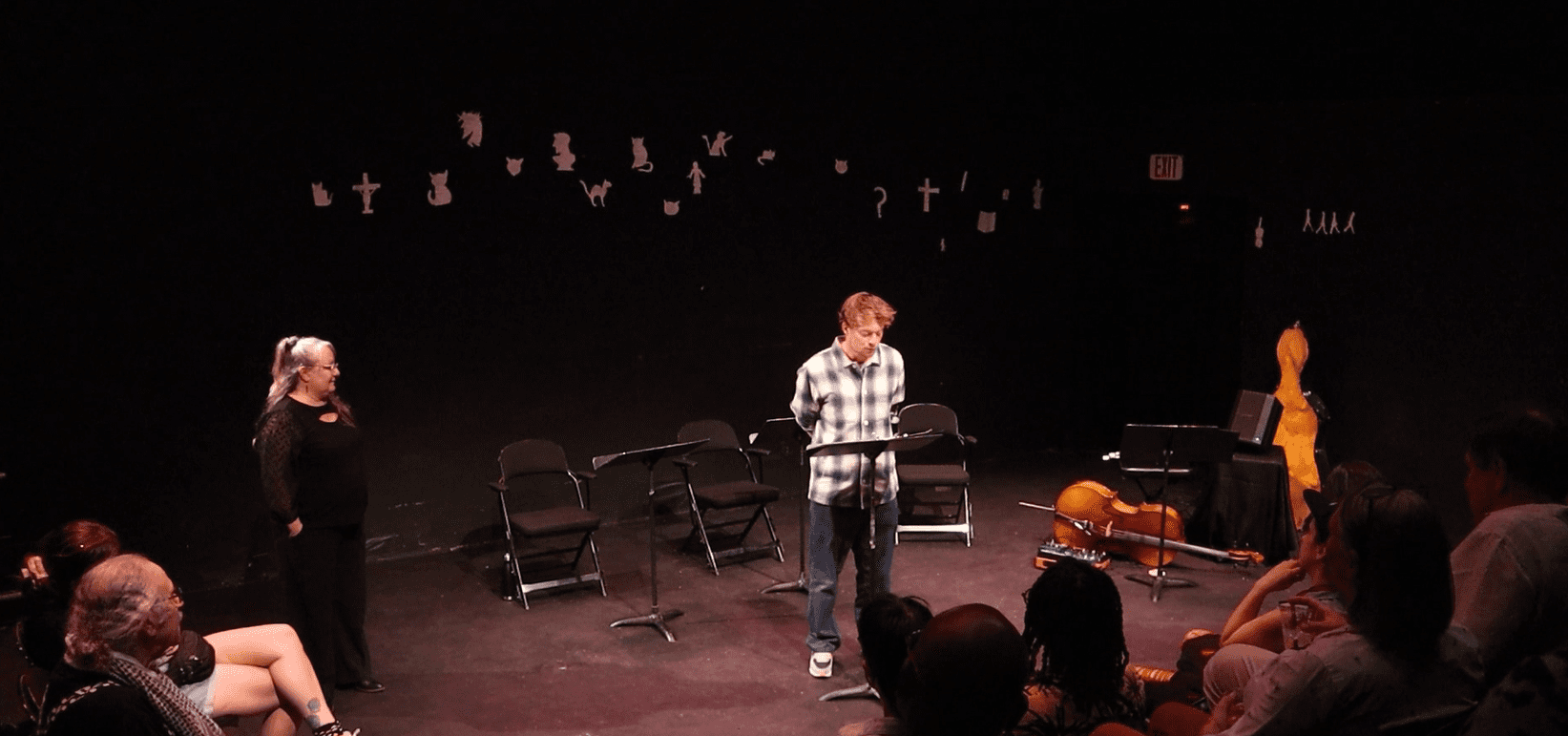
The following was spoken by playwright Frank Siera as an introduction to the staged reading of his play Poetic Licence at 7 Stages on April 13, 2026.
In 2022, an exhibition space in Amsterdam called Beautiful Distress organised an exhibition inspired by the life and work of British playwright Joe Orton. Orton was a gay man in a time in the UK that homosexuality was considered both a mental illness and a crime. During the height of his career in the 60s, he was murdered by his life partner Kenneth Halliwell. Orton’s biographer described this crime as an act of jealousy, but also starts his biography by saying Joe and Kenneth were friends. Dr Emma Parker, a literature professor in Leicester and an expert on Joe Orton’s life and work, has made it her ambition to set the record straight: Joe and Kenneth were lovers, and the moment Kenneth killed both Joe and himself was more likely a state of psychosis than an act of jealousy.
Emma Parker was involved as a researcher and source of information for the exhibition in Amsterdam. A friend of mine was involved too and told me about it, saying there would be videographers, sculptors and other visual artists involved in the exhibition. My response was, “how can you set up an exhibition about a playwright, and not include the one discipline that the subject of the exhibition mastered? And I happen to know a playwright who would be interested..” And that’s how it started.
My idea to write a play about Joe Orton happily coincided with the request of another friend of mine, a director, who asked me to write something about psychosis and the thin line between reality and fiction. Having been raised by a father who dealt with psychosis, this director had made it an ongoing quest in his artistic life to explore this theme. He was fascinated by how his father sometimes struggled to distinguish between fiction and reality, and feared he would suffer the same fate. Despite this, or maybe precisely because of this, he entered a career of playing with these elements, in theatre, first as an actor and then as a director. By taking control over fiction and reality, he hoped he would never not be able to know what’s real and what’s not. And now, he had asked me to write a play which made it clear how thin the line between the two can sometimes be.
And so the idea was born: I began writing a play about a playwright, using fiction inspired by reality to write about how the two are sometimes dangerously similar. I started researching Joe Orton, reading his work and his biography. Simultaneously, the other artists involved in the exhibition, started researching Orton too. We all discovered that Orton was a talented playwright, with a witty nose for dark humour and the ambition to playfully provoke and challenge the zeitgeist. But he also seemed to be somewhat self centered, with a hedonistic focus on having quick anonymous sex outside of his relationship with Kenneth; which in itself is not necessarily a problem, but compared to the insecure and sheltered nature of Kenneth who barely ever found pleasure outside of their relationship, and seldom left their small apartment in London, it didn’t seem very sympathetic. Let alone a more problematic element: the two of them would sometimes travel to Morocco to have sex with underaged teenage boys.
A meeting with all the artists involved was organised, to discuss the preparations for the event. During the meeting, the majority of the artists stated that now they had learnt more about the history of Joe Orton, they didn’t want to be involved anymore as long as Orton would still be the main topic of the exhibition. Even though I did understand the problems they had with Orton’s crimes with underaged boys – I felt the same way – I was also a bit surprised by their stance. My idea, instead of sweeping it under the rug and pretending that it had never taken place, was that we should talk about it. We should tell how it really went and then give the right context, formulate an opinion, ask challenging questions, provoke a conversation. Things that we don’t agree with now did happen in the past, and instead of ignoring them, we should address them and learn from them. It’s not about putting someone or his actions on a pedestal, it’s about using his life, work and actions as a starting point to have a conversation.
Which is why Orton’s harmful actions did end up being a part of this play. And also why he’s being criticised and condemned for it, in the play. Because let me be very clear: as much as I think we should challenge our prevailing conservative ideas of what a romantic relationship should look like, having sex with underaged people is wrong and harmful and illegal for all the right reasons. It’s also, needless to say but nevertheless very necessary to explicitly mention, very different from being a gay man. Being a gay man and enjoying consensual intimacy with another gay man is in itself joyful, harmless and perfectly normal, whereas the other is never consensual or harmless. It’s where we have to draw a very clear line of how far we can challenge our conservative ideas of what should be normal and what shouldn’t be. Especially in times of renewed and increased pressure on queer rights, it’s important to stress the difference. And it’s important to talk about it and not shy away from the conversation. About what is or should be normal, and what isn’t or shouldn’t be.
Because that is what POETIC LICENCE tries to do. It shows that over time, our perception of normality changes. Things that were seen to be insane and illegal in the 60s are now considered perfectly normal – or are, yet again, under pressure. It only goes to show how vulnerable our worldview is, and how we should never blindly accept what the world tells us to be the norm. Imagination, art and theatre can help in freely dreaming about a refreshing new world with new perspectives, but the absence of frames and boundaries can also sometimes lead to dangerous situations and the darkest corners of one’s mind. Especially for someone who already has difficulty to find the boundary between fantasy and reality. Like a critic wrote about the play: “In this way, the true purpose of Poetic Licence slowly becomes clear: it is an ode to the taboo-breaking power of imagination, which never loses sight of the dark side of a surrender to madness. Poetic Licence sketches a simultaneously oppressive and liberating portrait of the relationship between madness and exclusion. A surrender to fiction is like the wings of Icarus: an escape from the gravitational pull of stifling civic morality, but also a potentially fatal ascension.” And I couldn’t agree more.
The exhibition did take place, under a different name and with a broader theme – queer mental struggles in general – but was ultimately postponed because of financial difficulties. POETIC LICENCE did, however, premiere at the planned moment, as an event on its own. Dr Emma Parker came to visit from the UK and attended the premiere. She stated that although there have been more plays about Joe Orton than he had written himself, this was the first time she had seen a play so true to what she believed to be the real story. Even though, to balance the thin line between real and fictional, I took quite some poetic licence.